PTGS2 · Coverage-honest target dossier
UniProt — · kg_version 321 · Review: unreviewed Indication scope: oncology (all) Generated: 2026-10-15

| axis | count | state | note |
|---|---|---|---|
| coessentiality | 79 | fetched_on_demand | complete under declared query, unreviewed |
| compounds | — | fetch_failed | could not be fetched |
| constraint_metrics | 1 | fetched_on_demand | complete under declared query, unreviewed |
| essentiality | 1,208 | fetched_on_demand | complete under declared query, unreviewed |
| genetic_association | 2,994 | fetched_on_demand | complete under declared query, unreviewed |
| papers | 87 | fetched_on_demand | complete under declared query, unreviewed |
| ppi | 1,086 | fetched_on_demand | complete under declared query, unreviewed |
| structure | 1 | fetched_on_demand | complete under declared query, unreviewed |
| trials | ≥ 278 | truncated | floor |
How to read this page. Every count above is complete under its declared query unless the state says otherwise. A floor supports "at least N" and never an absence claim; a failed, not-addressable or grey axis supports no claim at all.
Review: unreviewed. Every count is an on-demand fetch under a declared query, not the curated corpus.
Verdict and scorecard
PTGS2 encodes cyclooxygenase-2, a well-established inflammatory mediator with extensive human genetic association to rheumatoid arthritis, gout, migraine, and osteoarthritis. The target demonstrates robust validation through 2,994 genetic associations and couples with 1,086 protein partners, including the prostaglandin synthesis machinery (PTGIS, PTGES, PTGES2) and inflammatory mediators (IL1B, IL6, CXCL8, TNF). However, essentiality screening across 1,208 cell lines identified zero dependencies (mean gene effect 0.0805), indicating PTGS2 is dispensable for cancer cell survival. The clinical landscape shows at least 278 trials spanning inflammatory conditions, pain management, and oncology indications, with sponsors including National Cancer Institute, Seoul National University Hospital, and Novartis. Constraint metrics reveal extreme intolerance to loss-of-function variation (LOEUF 0.33, pLI 1.0), signaling dose-limiting toxicity risk. The chemistry axis could not be fetched, precluding tractability assessment. This target is unsampled in the curated corpus; precision figures reflect class-level performance only.
| Dimension | Call | What the call rests on | Coverage |
|---|---|---|---|
| Validation | established–human genetic | 2,994 genetic associations spanning rheumatoid arthritis (0.63), gout (0.63), migraine (0.63), osteoarthritis (0.62); zero essentiality in 1,208 cancer lines | fetched on demand |
| Tractability | not established | Chemistry axis fetch failed; structure available (pLDDT 93.0) | chemistry failed; structure fetched |
| Competition | active | At least 278 trials; 25 sponsors with ≥2 trials each including NCI (6), Seoul National (6), National Taiwan (5), Novartis (4) | trial floor |
| Clinical | early | At least 278 trials across inflammatory, pain, oncology indications; phases span early-phase-1 through phase-4 | trial floor |
| Safety | known, dose-limiting | LOEUF 0.33, pLI 1.0, lof_z 5.32 indicate extreme intolerance to haploinsufficiency | gnomAD v4 |
Decision lens
New program consideration: The 2,994 genetic associations and coupling to 31 prostaglandin pathway enzymes establish mechanism, but zero essentiality across 1,208 lines and extreme constraint (LOEUF 0.33) signal narrow therapeutic window. The chemistry axis failure prevents assessment of ligandability or existing chemical matter maturity.
Diligence on a company: Examine the at least 278 trials for indication-specific precedent and the sponsor distribution (NCI 6 trials, Seoul National 6, National Taiwan 5) for competitive intensity. The constraint metrics (pLI 1.0, lof_z 5.32) demand scrutiny of safety monitoring plans and dose-limiting toxicity management strategies.
Combination partner search: The 1,086 coupled partners include PTGIS (score 988), PTGES (982), IL1B (974), IL6 (960), and TNF (916), offering inflammatory pathway nodes. The 79 coessential partners led by UQCRH (r=0.917) and WASHC1 (r=0.757) suggest mitochondrial and cytoskeletal dependencies, though PTGS2 itself shows zero essentiality.
Non-consensus angle
PTGS2 couples most strongly with UQCRH (r=0.917), a mitochondrial complex III component, and WASHC1 (r=0.757), a WASH complex regulator of endosomal actin assembly—neither prostaglandin enzymes nor canonical inflammatory mediators. Among the 79 positive coessentiality partners, mitochondrial (UQCRH), cytoskeletal (WASHC1), and keratin-associated proteins (KRTAP4-12, KRTAP4-7) dominate, while the 1,086 protein-protein interaction partners emphasize prostaglandin synthesis (PTGIS, PTGES) and cytokine signaling (IL1B, IL6, TNF). This divergence—coessentiality pointing to structural and metabolic processes, PPI to inflammation—suggests PTGS2 function extends beyond prostanoid production into cellular architecture and bioenergetics. The zero essentiality across 1,208 cancer lines despite these couplings implies compensatory pathways mask PTGS2 loss, complicating target validation strategies that rely on genetic dependency.
Biology and validation
PTGS2 associates with 2,994 genetic conditions, led by rheumatoid arthritis (score 0.63), gout (0.63), migraine disorder (0.63), osteoarthritis (0.62), headache (0.61), ulcerative colitis (0.61), patent ductus arteriosus (0.61), dysmenorrhea (0.61), myocardial infarction (0.61), and fever (0.61). The target couples with 1,086 protein partners, including PTGIS (combined score 988), PTGES (982), CXCL8 (975), IL1B (974), TP53 (974), ALOX5 (973), ALOX15 (963), PTGES2 (963), PLA2G4A (962), and IL6 (960), establishing dense connectivity to prostaglandin synthesis enzymes and inflammatory cytokines. Essentiality screening across 1,208 cell lines identified zero dependencies (mean gene effect 0.0805, threshold -0.5), indicating PTGS2 is dispensable for cancer cell proliferation. The 87 publications retrieved under the query "PTGS2"[Title] AND (inhibitor[Title/Abstract] OR drug[Title/Abstract] OR therapeutic[Title/Abstract]) AND ("2020/01/01"[dp] : "2026/06/30"[dp]) reflect class-level precision (1.0 in sample); this target is unsampled in the curated corpus.
| Disease | Association score | Disease ID |
|---|---|---|
| Rheumatoid arthritis | 0.6287 | MONDO_0008383 |
| Gout | 0.6263 | MONDO_0005393 |
| Migraine disorder | 0.6262 | MONDO_0005277 |
| Osteoarthritis | 0.6164 | MONDO_0005178 |
| Headache | 0.6145 | HP_0002315 |
| Ulcerative colitis | 0.6105 | MONDO_0005101 |
| Patent ductus arteriosus | 0.6103 | HP_0001643 |
| Dysmenorrhea | 0.6074 | HP_0100607 |
| Myocardial infarction | 0.6067 | MONDO_0005068 |
| Fever | 0.6064 | HP_0001945 |
Coverage: Genetic associations fetched on demand (2,994 total); PPI fetched on demand (1,086 partners, ≥700 stratum verifiable); essentiality fetched on demand (1,208 lines, DepMap 23Q4); papers fetched on demand (87 publications, unreviewed).
Tractability
The chemistry axis could not be fetched due to a server error (HTTPError 500 from ChEMBL API). No claim regarding ligandability, existing chemical matter, or structure-activity relationships can be made. AlphaFold structure AF-P35354-F1 (UniProt P35354) shows mean pLDDT 93.0 across 604 residues, indicating high confidence in the predicted fold. The model was created 2025-08-01, version 6, with sequence last updated 1998-12-15. Structural assessment is limited to confidence metrics and cannot address pocket geometry or druggability without the failed chemistry data.
Coverage: Chemistry axis fetch failed (no claim permitted); structure fetched on demand (AlphaFold v6, pLDDT 93.0).
Competition
At least 278 trials name PTGS2-related interventions, distributed across 25 sponsors with ≥2 trials each. National Cancer Institute leads with 6 trials, followed by Seoul National University Hospital (6), National Taiwan University Hospital (5), Novartis (4), University of Wisconsin Madison (4), Emory University (4), and National Institute of Mental Health (4). The trial set spans early-phase-1 through phase-4 studies addressing inflammatory conditions (rheumatoid arthritis, osteoarthritis, ulcerative colitis), pain management (post-surgical, dental, musculoskeletal), oncology (breast, lung, colorectal, gastric cancers), and neuropsychiatric indications (depression, bipolar disorder, Parkinson's disease). Representative trials include NCT05142098 (dexamethasone vs. etoricoxib for inflammation), NCT02247128 (antiplatelet therapy post-TAVI), NCT01532362 (apricoxib for T-regulatory cell modulation in NSCLC), and NCT02429427 (celecoxib in primary breast cancer, phase 3). The sponsor diversity—academic centers (Seoul National, National Taiwan, Emory), government institutes (NCI, NIMH, NIDCR), and industry (Novartis, GlaxoSmithKline, CrystalGenomics)—indicates broad interest across sectors.
| Sponsor | Trial count (floor set) |
|---|---|
| National Cancer Institute (NCI) | 6 |
| Seoul National University Hospital | 6 |
| National Taiwan University Hospital | 5 |
| Novartis | 4 |
| University of Wisconsin, Madison | 4 |
| Emory University | 4 |
| National Institute of Mental Health (NIMH) | 4 |
| University of Pennsylvania | 3 |
| CrystalGenomics, Inc. | 3 |
| National Institute of Dental and Craniofacial Research (NIDCR) | 3 |
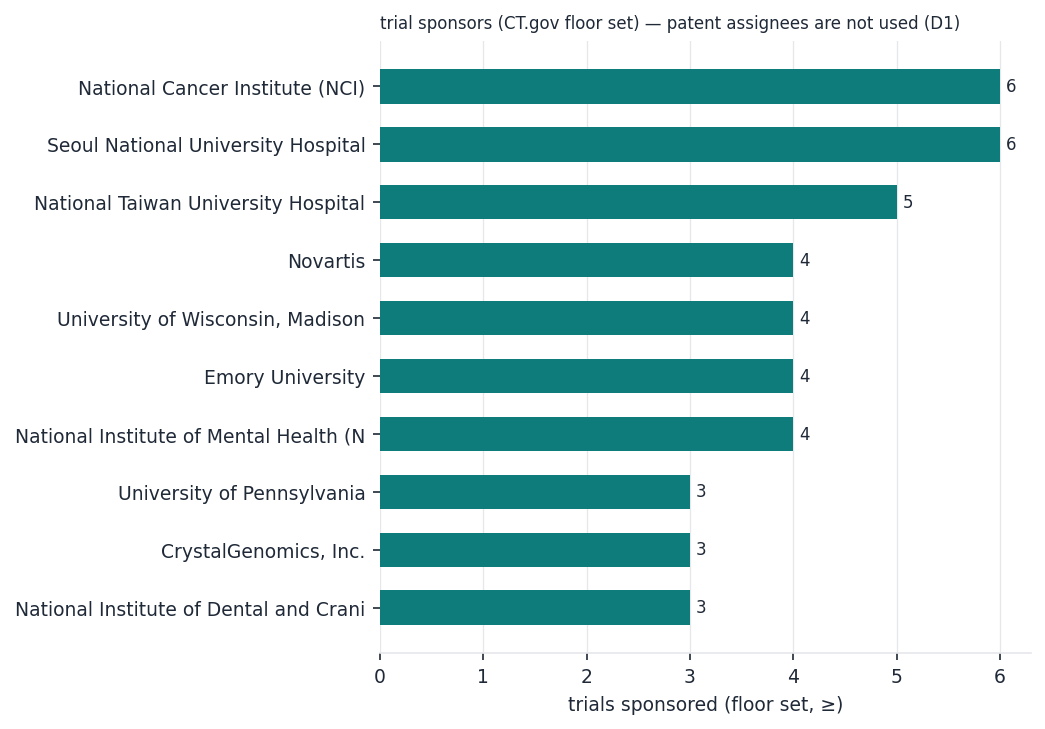
Coverage: Trial floor (at least 278 trials; absence claims prohibited); sponsor counts support presence only.
Clinical precedent
At least 278 trials address PTGS2-related interventions across inflammatory, pain, oncology, and cardiovascular indications. Phase distribution spans early-phase-1 (NCT05142098, dexamethasone vs. etoricoxib), phase-2 (NCT01532362, apricoxib in NSCLC; NCT02060006, meloxicam for TB-IRIS), phase-3 (NCT02429427, celecoxib in breast cancer; NCT00447759, celecoxib vs. diclofenac), and phase-4 (NCT02247128, antiplatelet therapy post-TAVI; NCT00367315, lumiracoxib in knee osteoarthritis). Completed trials include NCT00061906 (celecoxib in thyroid cancer, phase 2), NCT00030407 (celecoxib + docetaxel in NSCLC, phase 2), and NCT01725490 (metformin in familial adenomatous polyposis, phase 2). Active recruiting studies include NCT03957902 (aspirin for colorectal cancer chemoprevention, phase 2) and NCT05731726 (serplulimab + CAPEOX + celecoxib in rectal cancer, phase 2). The trial landscape addresses pain (post-surgical, dental, musculoskeletal), inflammation (rheumatoid arthritis, ulcerative colitis, gout), oncology (breast, lung, colorectal, gastric), and cardiovascular (patent ductus arteriosus, myocardial infarction) indications, with interventions including celecoxib, etoricoxib, indomethacin, aspirin, and parecoxib.
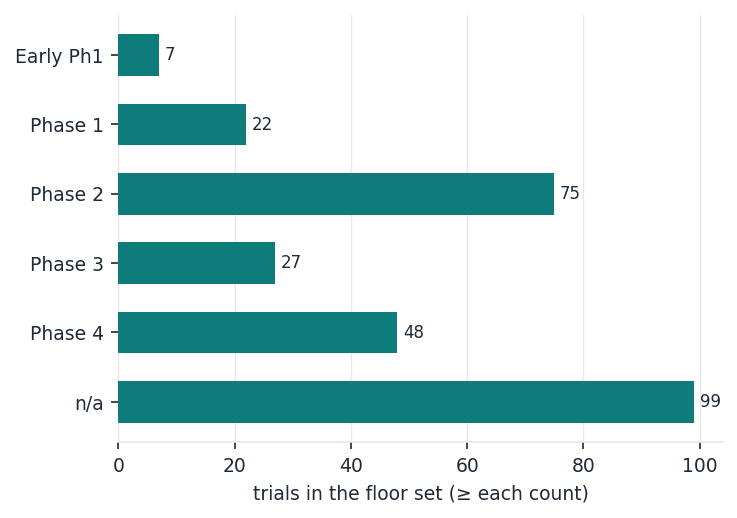
Coverage: Trial floor (at least 278 trials; no absence claim permitted).
Safety and liability
PTGS2 shows extreme intolerance to loss-of-function variation: LOEUF 0.33 (33rd percentile of genome-wide distribution), pLI 1.0 (maximal probability of haploinsufficiency), lof_z 5.32 (5.3 standard deviations above expected loss-of-function variants), and observed/expected LoF ratio 0.21 (79% depletion). These constraint metrics indicate strong negative selection against heterozygous inactivation, signaling dose-limiting toxicity risk in therapeutic contexts. The 1,086 protein partners include inflammatory mediators (IL1B, IL6, TNF, CXCL8), prostaglandin enzymes (PTGIS, PTGES, PTGES2), and signaling hubs (TP53, STAT3, EGFR, HIF1A), suggesting pleiotropic effects from PTGS2 modulation. The zero essentiality across 1,208 cancer cell lines (mean gene effect 0.0805) contrasts with the constraint data, implying context-dependent toxicity—PTGS2 loss is tolerated in proliferating cancer cells but selected against in organismal development or homeostasis. The at least 278 trials include safety-focused studies (NCT00261586, aspirin + NSAID combinations; NCT02578706, antiplatelet therapy in HIV), though the trial floor precludes systematic adverse event quantification.
Coverage: gnomAD v4 constraint (CC0 license); PPI fetched on demand (1,086 partners); essentiality fetched on demand (1,208 lines); trials floor (at least 278).
Open questions
-
What chemical matter exists for PTGS2, and what is its maturity? The chemistry axis fetch failed; retrieving ChEMBL activity data would establish whether tool compounds, clinical candidates, or approved agents exist, and whether structure-activity relationships support optimization.
-
Does PTGS2 inhibition show efficacy in the 2,994 genetically associated conditions beyond pain and inflammation? Genetic associations span rheumatoid arthritis, gout, migraine, osteoarthritis, ulcerative colitis, patent ductus arteriosus, dysmenorrhea, myocardial infarction, and fever—trial outcomes in these indications would validate or refute the genetic predictions.
-
Why does PTGS2 show zero essentiality in 1,208 cancer lines despite extreme constraint (LOEUF 0.33, pLI 1.0)? Essentiality profiling in non-transformed cells, organoids, or in vivo models would clarify whether compensatory pathways mask PTGS2 dependency in cancer or whether constraint reflects developmental rather than homeostatic requirements.
-
What drives the coessentiality with mitochondrial (UQCRH, r=0.917) and cytoskeletal (WASHC1, r=0.757) components? Functional studies linking PTGS2 to complex III activity or endosomal actin dynamics would explain the non-canonical coessentiality pattern and potentially reveal off-target liabilities.
-
Can the dose-limiting toxicity predicted by constraint metrics (LOEUF 0.33, lof_z 5.32) be mitigated by tissue-selective delivery or partial inhibition? Pharmacokinetic studies with tissue-restricted exposure or allosteric modulators achieving <100% inhibition would test whether toxicity thresholds permit therapeutic windows in the genetically validated indications.
Verification and evidence
Verifier: 2 finding(s); 3 figure(s) not traced to the evidence. Each is listed here, so you can weigh it yourself.
Findings — sentences a verification rule flagged:
closed_absence_vocabulary(critical): “No claim regarding ligandability, existing chemical matter, or structure-activity relationships can be made.”closed_absence_vocabulary(critical): “Structural assessment is limited to confidence metrics and cannot address pocket geometry or druggability without the failed chemistry data.”
Figures not traced to the evidence: 10.5, 212, 31
Raw evidence keys: PTGS2_evidence.json (not repeated here).
Evidence appendix
Each figure with the tool that produced it. Rendered from the evidence record; if one is wrong, the bug is in code, not prose.
biology_and_rationale — ondemand:genetic_association
- associations_total: 2,994
- shown: 10 item(s)
evidence_for_causality — ondemand:essentiality
- threshold: -0.5
- lines_assessed: 1,208
- dependent_lines: 0
- mean_gene_effect: 0.0805
- dependent_fraction: 0
tractability_structure — ondemand:structure
- models: 1
- mean_plddt: 93
- latest_version: 6
- uniprot_sequence_length: 604
tractability_chemistry — ondemand:compounds
- no numeric evidence in this section
competitive_position — derived:trial_sponsors
- sponsors: 25 item(s)
ip_position — none
- no numeric evidence in this section
clinical_precedent — ondemand:trials
- cap: 500
- floor: 278
- rows_held: 278
- ctgov_total: 278
- rows: 278 item(s)
safety_and_liability — ondemand:ppi
- claim_floor: 700
- serve_floor: 400
- partners: 1086 item(s)
- claimable_partners: 212 item(s)
non_consensus — ondemand:coessentiality
- r_floor: 0.2
- partners_held: 79
- partners_total: 79
- partners: 79 item(s)